


 English
 中文简体
中文简体
 Home / News / Industry News / Does Fire Retardant Paint Really Work? Facts, Standards, and Practical Limits
 Industry News
Does Fire Retardant Paint Really Work? Facts, Standards, and Practical Limits
2026-08-14
Content
- 1 What Fire Retardant Paint Actually Does — and What It Cannot Do
- 2 Two Main Technology Types: Intumescent and Non-Intumescent Coatings
- 3 What Do Fire Test Standards Actually Prove?
- 4 How Fire Retardant Paint Performs on Structural Steel
- 5 Does Fire Retardant Paint Work on Wood?
- 6 Why Fire Retardant Paint Fails in Practice
- 7 How to Choose the Right Fire Protection Coating for Your Project
- 8 Cost, Procurement and Inspection of Fire Retardant Paint
- 9 Frequently Asked Questions About Fire Retardant Paint
- 9.1 Does fire retardant paint make wood or steel fireproof?
- 9.2 How long does fire retardant paint last?
- 9.3 What does a 60-minute fire rating actually mean?
- 9.4 Can fire retardant paint be used on wood?
- 9.5 Does outdoor steel need a topcoat over intumescent paint?
- 9.6 Do I need an anti-corrosion primer under fire retardant paint on steel?
- 9.7 Is fire retardant paint still effective after a fire?
- 9.8 How can a buyer verify a supplier's fire performance claims?
- 10 The Bottom Line for Specifiers and Buyers
Short answer: yes, fire retardant paint works — but not in the way the word "fireproof" suggests. It does not make steel or wood immune to fire, and it will not extinguish a burning building. What it does, when correctly specified and applied, is delay the thermal damage that fire causes: it slows ignition and flame spread on combustible surfaces, it insulates structural steel from heat, and it buys the 30 to 120 minutes of escape and response time that modern fire codes are built around.
A structural engineer responsible for a 12-story commercial building recently asked our technical team a blunt question: "I see suppliers promising fireproof paint. If a real fire starts, will that coating actually hold up?" That is the right question to ask, because the marketing language around fire-retardant and intumescent coatings is often much more confident than the engineering data.
The honest answer, based on standard furnace tests and on fire-protection projects delivered across airport terminals, exhibition centers, sports venues, hospitals and industrial plants, is that fire retardant paint genuinely works as a passive fire protection system — but its performance is conditional. The coating must be the right type, applied at the right dry film thickness, over the right primer, and protected from weathering where it is exposed. Change any one of those conditions and a "60-minute rated" system can behave like a decorative paint.
This guide explains what "working" actually means, how the two main coating families achieve it, what a test certificate really proves, where good systems fail in practice, and how to buy fire protection with realistic expectations. To see the char-forming reaction described in this guide happen in real time, the short clip below shows an intumescent coating expanding under direct flame exposure.
550°C Critical design temperature for unprotected structural steel
30–120min Realistic fire resistance range coatings deliver in standard tests
20–50× Typical char expansion ratio of a thin-film intumescent coating
10–30min Time unprotected steel can take to reach critical temperature in a developed fire
What Fire Retardant Paint Actually Does — and What It Cannot Do
Fire retardant paint is a passive fire-protection measure. Unlike active systems such as sprinklers or fire alarms, it does not detect fire, suppress flames or call for help. It simply sits on the substrate and changes how that substrate behaves when heat arrives. Understanding that distinction is the first step to specifying it correctly.
The honest one-line answer
For steel, fire retardant paint delays the moment when the metal reaches its critical failure temperature. Bare structural steel loses roughly half of its room-temperature yield strength at about 550°C. A developed room fire can reach 800 to 1000°C within the first 30 minutes, so unprotected steel can fail in as little as 10 to 20 minutes. A properly applied intumescent or cementitious coating can push that failure point to 60, 90 or even 120 minutes, giving occupants time to evacuate and fire services time to attack the fire before the structure surrenders.
For wood and other combustible surfaces, the mechanism is different. Fire retardant paint delays ignition, reduces the rate of flame spread and lowers the heat release rate during the early stages of a fire. A small ignition source may char the surface without producing a fast-spreading flame, which is exactly the difference between a localised fire and a flashover that consumes an entire room.
What it will never do
Use the term "fireproof" with caution. No coating can make a material immune to fire. A fire of sufficient duration and intensity will eventually overwhelm every passive protection system. Fire retardant coatings are rated for a time limit, not for an unlimited guarantee. They also will not protect where they are physically damaged, where they are left exposed to weather without a compatible topcoat, or where they are applied over an incompatible anti-corrosion primer that causes delamination.
This matters commercially as much as technically. Specifiers who treat fire retardant paint as an insurance policy rather than an engineered system create a false sense of safety. The coating that prevents a structural collapse for one hour in a furnace test can fail in fifteen minutes on site if the dry film thickness is half the specification, if the primer was skipped, or if the can was stored past its shelf life. That is why the rest of this article focuses on the conditions that make the difference between a coating that works and a coating that merely looks like one.
| Common claim | What the evidence shows |
|---|---|
| "This is fireproof paint" | No coating is fireproof in the literal sense. Certified products provide a limited fire resistance period, usually 30 to 120 minutes. |
| "One coat is enough" | The rating is tied to dry film thickness. A decorative coat at half the specified thickness gives far less than the rated protection. |
| "Works on all substrates" | Coating systems are tested per substrate. A system verified on steel is not automatically verified on wood, concrete or gypsum board. |
| "Apply once, forget forever" | Humidity and UV degrade many intumescent binders. Most systems need a compatible topcoat and a maintenance schedule. |
| "Stops the fire from starting" | Fire retardant paint does not prevent ignition from a ready heat source. It slows flame spread and delays structural damage. |
Two Main Technology Types: Intumescent and Non-Intumescent Coatings
When someone asks whether fire retardant paint works, the accurate answer depends on which of the two main families they mean. Both are legitimate, but they protect through completely different physical mechanisms, and they suit different projects.
Thin-film
Intumescent Coating
- 0.3–1.5 mm dry film thickness
- 20–50× char expansion
- 60–120 min typical steel rating
Best for: architectural steel, indoor and protected outdoor areas
Thick-film
Cementitious / Gypsum Coating
- 8–30 mm dry film thickness
- Fixed mineral thermal barrier
- 90–180 min typical steel rating
Best for: industrial plants, tunnels, humid or aggressive zones
Intumescent thin-film coatings
Thin-film intumescent coatings are the type used on most architectural and structural steel in commercial buildings. They are applied at a dry film thickness of roughly 300 to 1000 micrometres, depending on the fire rating and the steel section factor. When exposed to heat above approximately 250 to 300°C, a chemical reaction inside the film makes it swell into a thick, stable char layer — typically 20 to 50 times the original film thickness. This char has very low thermal conductivity. It acts like a thermal blanket that slows the transmission of heat to the steel underneath, keeping the metal below its critical temperature for the rated period.
The quality of an intumescent system depends on the structure of that char. A dense, crack-resistant, well-adhered char insulates longer; a brittle char that crumbles under a water hose stream delivers far less protection. When comparing suppliers, check whether the product is described with measurable expansion performance. Some of our own systems, for example, are formulated around a 20-times expansion ratio, which is a useful benchmark for thin-film performance in 60 to 120 minute applications.
For a practical look at both product families, you can browse the complete fireproof coatings product range available from our plant.
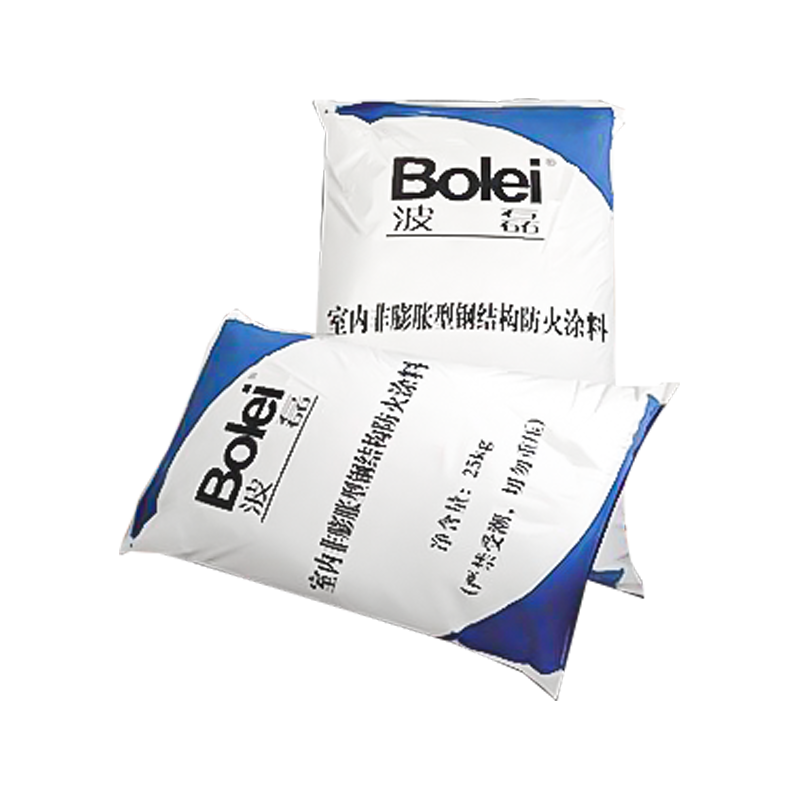 Fireproof Coating Manufacturers, Fire Proof Paint Suppliers
Thick-film non-intumescent coatings
Cementitious and gypsum-based non-intumescent coatings protect in a different way. Instead of expanding, they rely on a thick mineral layer, usually 8 to 30 millimetres, which has inherently low thermal conductivity. The layer physically separates the steel from the fire, and part of its heat-absorption comes from moisture in the matrix evaporating and carrying energy away. These systems are heavier, slower to apply and less visually appealing than thin-film intumescents, but they are often more robust in industrial environments, tunnels and other aggressive settings where water resistance and physical durability matter as much as fire performance.
| Property | Thin-film intumescent | Thick cementitious / gypsum |
|---|---|---|
| Typical dry thickness | 0.3 to 1.5 mm | 8 to 30 mm or more |
| Protection mechanism | Expands into a low-conductivity char | Built-in mineral thermal barrier |
| Best-used substrates | Structural steel, some wood systems | Steel, concrete, industrial surfaces |
| Appearance after application | Close to normal paint, smooth | Rough surface, usually needs rendering |
| Typical fire rating | 60 to 120 minutes on steel | 90 to 180 minutes depending on thickness |
| Best-suited environment | Indoor architectural steel, protected outdoor areas | Industrial, tunnels, humid and aggressive zones |
| Cost profile | Higher material cost, lower application labour | Lower material cost, higher labour and thickness |
If you want to understand the underlying chemistry in more detail, our engineers have prepared a practical guide to how fireproof coatings work to protect building structures, including the behaviour of char layers in a real fire.
What Do Fire Test Standards Actually Prove?
One word matters more than the entire brochure: rating. A supplier can claim a coating is "tested", but you should always ask a follow-up question: tested to which standard, at what dry film thickness, on which steel section factor, and for how many minutes? The answer separates genuine fire protection from a decorative coating with a confident datasheet.
The furnace curve and critical temperature
Fire resistance tests place a coated element in a furnace that follows a standard time-temperature curve. The ISO 834 curve, which forms the basis of many national standards, starts at room temperature and heats rapidly. The furnace reaches roughly 680°C in the first 10 minutes, around 945°C after one hour and close to 1050°C after two hours. During the test, thermocouples measure the temperature of the steel. A structural steel element is considered to fail when it reaches its critical temperature, typically 540 to 550°C, which is the point where the steel has lost approximately half of its room-temperature yield strength.
Furnace air temperature under the ISO 834 curve: roughly 680°C at 10 minutes, 945°C at 60 minutes and 1049°C at 120 minutes. Unprotected steel crosses its 550°C critical temperature well before the 10-minute mark of this curve.
The declared rating is therefore not a prediction of what happens in a real fire. It is the time the coated element survived a specific furnace curve, with a specific section factor, at a specific coating thickness. Change the substrate, the section size or the thickness, and the rating no longer applies.
How ratings translate to project decisions
Building codes typically specify the required fire resistance period based on the building height, occupancy and structural role of the element. A single-storey industrial hall may require 60 minutes for its steel frame; a high-rise office building may require 120 minutes for columns and 90 minutes for beams. The coating manufacturer must confirm that the selected product, at the proposed thickness, achieves the required rating for the specific section factor of the steel member. That is why a raw percentage claim of "30 minutes protection" is meaningless without the section factor and thickness behind it.
| Standard | Region | What it verifies |
|---|---|---|
| ISO 834 | International | Standard time-temperature curve for fire resistance tests of building elements |
| ASTM E119 | North America | Fire exposure of building construction, with structural and hose-stream testing |
| BS 476 Part 20/21 | United Kingdom | Fire resistance of elements of construction, including loaded steel columns and beams |
| EN 13381-8 | Europe | Method for determining the contribution of applied reactive protection to steel members |
| GB 14907 | China | Performance and fire resistance of fire retardant coatings for steel structures |
What a trustworthy test report must state
When you receive a test certificate from a coating manufacturer, check that it clearly identifies all of the following:
- the test standard and its edition year;
- the substrate type and steel section factor (perimeter divided by cross-sectional area, normally expressed in reciprocal metres);
- the critical steel temperature used, usually 550°C;
- the dry film thickness (DFT) of the fire coating, in microns;
- whether an anti-corrosion primer and topcoat were part of the tested system;
- the time at which the element reached the critical temperature;
- the declared fire resistance rating based on that result.
If the report does not state these details, it has limited engineering value. For projects where the steel is fabricated in China or the specification references Chinese standards, GB 14907 reports are widely used and accepted; international buyers should compare the test methodology carefully with the local standard required by the project.
How Fire Retardant Paint Performs on Structural Steel
Steel is where fire retardant paint shows its clearest value, because unprotected steel fails silently. It does not burn, it does not smoke — it just loses strength until the structure deforms and collapses. This sudden failure is the reason modern building codes treat structural steel fire protection as mandatory in most occupied buildings.
Why bare steel fails so quickly
Structural steel is an excellent heat conductor. When exposed to fire, heat travels quickly through the cross-section, and the metal's load-bearing capacity drops steadily as temperature rises. At approximately 350°C, noticeable loss of strength begins. By 500 to 550°C, the steel retains roughly half of its room-temperature yield strength. At 700°C, it has little structural capacity left. In a fully developed compartment fire that reaches 900 to 1000°C, unprotected steel can reach the critical 550°C threshold in 10 to 30 minutes, depending on the section size. For beams and slender members with a high section factor, failure can be particularly fast.
Approximate room-temperature yield strength retained by unprotected structural steel as temperature rises. Strength loss accelerates sharply past 350°C, and by 550°C the steel has lost roughly half its capacity.
What the intumescent char actually changes
The expanded char layer works because its thermal conductivity is dramatically lower than that of steel — roughly 0.1 W per metre-kelvin for char, compared with around 50 W per metre-kelvin for structural steel. That two-to-three order-of-magnitude difference slows the heat flow into the metal, stretching the time-to-critical-temperature from minutes to a full hour or more. The thicker the char and the more stable its structure, the longer the protection.
Indicative intumescent dry film thickness (DFT) range needed to reach common steel fire ratings; the exact value always depends on the product formulation and the member's section factor.
The most useful number for a specifier is not simply the rating, but the combination of section factor and DFT. A heavy column with a low section factor of 80 per metre needs far less coating than a slender beam at 250 or 300 per metre to achieve the same rating. This is why a supplier's catalogue table showing "60 minutes = 450 µm" should always be checked against the exact section factor of your member.
The mechanism behind this protection is explained in more technical detail in our guide to how fireproof coatings work to protect building structures, which covers the char-forming chemistry and its practical limits. In real projects, you can see how these specifications are applied in our record of the fire protection coating work on the Hangzhou International Expo Center phase II project, where fire ratings, DFT control and compatibility with anti-corrosion primers were documented on a large public building.
Does Fire Retardant Paint Work on Wood?
Wood is a combustible material, so the expectations for fire retardant paint are different from steel. The coating will not make a timber beam behave like a steel beam in a furnace test. What it does is change the early stage of fire development, which is often the stage that determines whether an incident becomes a catastrophe.
What happens to unprotected wood
Wood starts to ignite at roughly 250 to 300°C when exposed to a sustained heat source. Once ignited, flames spread across the surface and the heat release rate rises quickly. In a room, this accelerating heat release is what drives flashover — the moment when all combustible surfaces in the room ignite almost simultaneously. Once flashover has occurred, structural timber sections begin to char away at a predictable rate, and the load-bearing cross-section shrinks until the element can no longer carry the applied load.
What the coating changes in practice
A well-formulated fire retardant coating on wood delays ignition, reduces the flame spread index and lowers the heat release rate in the early fire growth phase. This gives more time for detection, evacuation and intervention. In reaction-to-fire classifications such as the European EN 13501-1 or the North American ASTM E84, treated wood can achieve a better class than untreated wood, which is often the difference between being accepted or rejected by a building code.
The limitation is equally important: fire retardant paint on wood is not a structural fire protection system. A load-bearing timber beam that needs to survive 60 minutes in a fire requires a larger cross-section, the use of engineered timber designed for char rate, or the calculation of the residual section after charring. The paint is a valuable layer of protection, but engineers should not rely on it as the only line of defence for load-bearing timber members.
Why Fire Retardant Paint Fails in Practice
Fire retardant coatings rarely fail because the chemistry is wrong. They fail because the conditions in the field are different from the conditions in the furnace test. We have seen the same pattern across dozens of steel structure inspections: the product was certified, the material was delivered, but somewhere between the can and the completed steel member, the system was compromised.
01
Poor surface preparation
Bare steel that is not blast-cleaned and primed gives the char nothing to grip. If the fire coating delaminates from the primer, protection time collapses to very little.
02
DFT below specification
Fire resistance is a mathematical function of thickness. A film at 60% of the specified DFT can deliver far less than 60% of the rated protection.
03
Weathering & UV exposure
Intumescent additives degrade outdoors without a compatible exterior-grade topcoat and a maintenance schedule.
04
Incompatible primer/topcoat
A non-approved topcoat can soften the intumescent film or block its expansion, and a non-porous primer reduces adhesion.
Poor surface preparation
Most intumescent systems are not designed to be applied directly to bare steel. The steel should be blast-cleaned to a defined standard, then primed with a compatible anti-corrosion primer. Mill scale, rust, oil, grease and moisture all reduce adhesion. If the fire coating delaminates from the primer, the char has nothing to grip when it expands, and it simply falls away in a fire. The protection time collapses to very little.
Dry film thickness below specification
This is the single biggest cause of field failure. Fire retardant paint is often treated by contractors like a decorative paint: one generous coat, maybe two, and the invoice is sent. But fire resistance is a mathematical function of thickness. A film applied at 60% of the specified DFT does not deliver 60% of the protection; it can deliver far less, because the char layer formed under fire conditions is thinner and less complete. Every critical member in our project records is checked with a dry film thickness gauge, and the results are shared with the client before the steel is enclosed.
Weathering, humidity and UV exposure
Intumescent additives — particularly the acid source and carbon-forming compounds — can degrade over time when exposed to outdoor weather. Research on exterior fire-retardant coatings, including wildfire-focused studies published by fire-adapted research groups, has repeatedly found that generic coatings tested in new condition lose much of their fire performance after months of outdoor exposure without maintenance. This does not mean fire retardant paint cannot work outdoors. It means the coating must be an exterior-grade formulation, protected with a compatible durable topcoat, and inspected on a maintenance schedule.
Incompatible primers and topcoats
A topcoat that is not approved by the coating manufacturer can soften the intumescent film, block its expansion or change the char structure. Similarly, an anti-corrosion primer with a smooth, non-porous surface can reduce the mechanical grip of the intumescent layer. For this reason, the entire system — primer, fire coating, intermediate coat if specified, and topcoat — should come from one manufacturer or be verified as a compatible combination by the fire coating manufacturer. When we supply fire protection for steel structures, we provide the full system documentation, because a fragmented supply chain is also a fragmented responsibility chain.
How to Choose the Right Fire Protection Coating for Your Project
Choosing between intumescent and cementitious systems is not about which one is "better" in general, but about which one fits your substrate, environment, fire rating, aesthetic constraints and project schedule. The right answer is project-specific, and an experienced supplier will always ask about the steel section factor before quoting a thickness.
Seven questions to ask before choosing a system
- What fire resistance period does the local building code require for this structural element?
- What is the section factor (Hp/A) of the steel members that need protection?
- Is the member indoors, in a semi-exposed area, or fully exposed to weather?
- Is the coating required only for fire performance, or also for corrosion protection and appearance?
- Will the construction schedule tolerate the drying and recoating times of the selected system?
- Does the project require third-party inspection and verified test reports from an accredited laboratory?
- Who is responsible for DFT measurement and for repair after installation?
Matching the product family to the building type
For architectural steel in commercial buildings, exhibition halls, airports and stadiums, thin-film intumescent systems are usually the natural choice. They keep the steel visibly slender, they can be topcoated in any color, and they achieve common ratings at a practical thickness. For industrial plants, tunnels, underground car parks and structures exposed to humidity, thick-film cementitious or gypsum systems often perform better because the mineral matrix does not depend on organic char chemistry to the same degree.
Ultra-thin intumescent protection for architectural steel
Where the fire coating must look like a high-quality finish, our solvent-based ultrathin intumescent fireproof coating with 20-times expansion is specified for steel sections in commercial and public buildings. It is applied over anti-corrosion primer at the tested DFT and finished with a topcoat. Fire ratings of 60 and 120 minutes are achievable under standard test conditions, and the thin film keeps the steel profile clean and elegant.
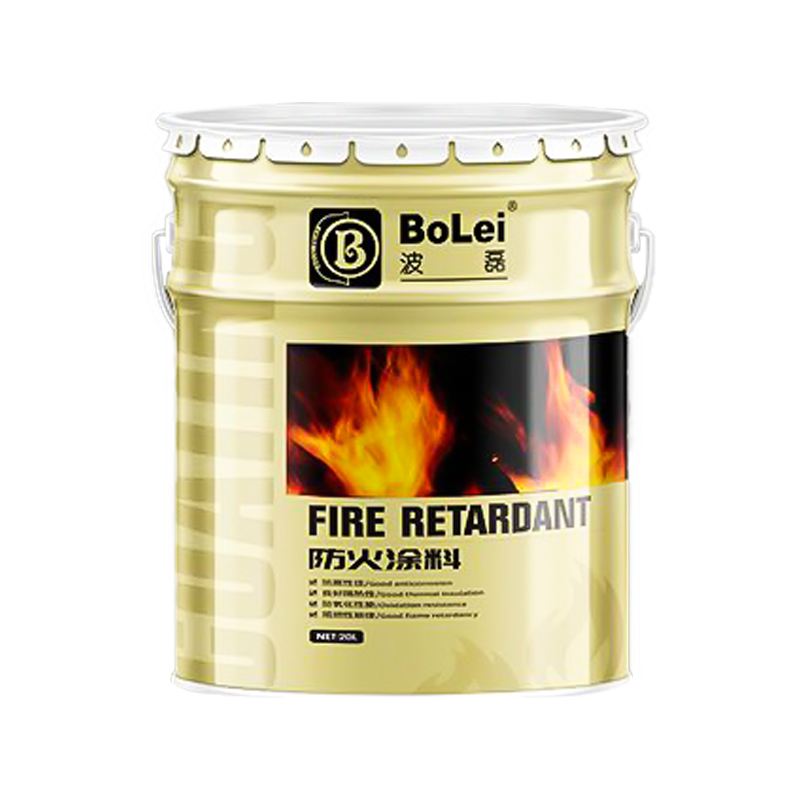 Custom Ultra-Thin Intumescent Fireproof Coating (20 times expansion) Manufacturer
Cement-based thick protection for industrial environments
For structural steel in industrial plants, tunnels and public utility buildings where appearance matters less than robust durability, our cement-based thick fireproof coating provides high fire resistance periods at a thicker DFT. The mineral matrix limits heat transfer, resists moisture better than organic thin films, and is well suited to harsh operating conditions. It is also economical for simple steel elements that do not require a smooth architectural finish.
Custom Cement-Based Thick Fireproof Coating Manufacturers, OEM/ODM Suppliers
Planning fire protection together with corrosion protection
Fire protection and corrosion protection are often treated as two separate design tasks, but on a steel structure they live on the same surface. The primer must protect the steel from rusting during the service life, while also giving the intumescent layer a stable foundation. The topcoat must be durable enough for the environment without interfering with expansion. These relationships are analysed in our comparison of fireproof vs anti-corrosion coatings and their uses, which is a useful starting point when both protection functions are required on the same member.
Cost, Procurement and Inspection of Fire Retardant Paint
Fire retardant paint is a small percentage of the total cost of a steel-framed building, but the consequences of getting it wrong are disproportionate. The lowest price per litre often becomes the most expensive decision of the project when a structure fails its fire inspection or, worse, fails in a real fire.
What actually drives the total cost
Do not compare prices per kilogram of coating. Compare the cost per square metre of protected steel, at the specified DFT, for the required fire rating. The four main cost components are:
- material cost per square metre at the certified DFT;
- application labour, including surface preparation, priming, coating and topcoating;
- certified inspection and documentation, including DFT verification on site;
- maintenance planning, which includes inspection intervals and repair materials.
A thin-film intumescent product may cost more per litre than a cementitious product, but it applies quickly and at low thickness, which often makes it more economical for architectural steel. A thick cementitious system may have lower material cost but higher application labour, crane time and surface preparation cost. The right comparison is always the certified thickness-to-rating ratio for your exact section factor.
A practical procurement checklist
- Request the full type test report, and check that it lists your substrate, section factor, critical temperature, DFT and the exact standard.
- Write the DFT into the specification in microns, and require a certified coating inspector to measure it on critical members before the steel is enclosed.
- Confirm compatibility of the specified anti-corrosion primer, fire coating and topcoat in writing from the fire coating manufacturer.
- For outdoor steel, require an exterior-grade formulation and independent weathering data, not just a furnace test conducted on fresh coating.
- Check delivery dates, batch numbers and shelf life. Aged or improperly stored intumescent material may not expand to its design ratio.
- Ask for application guidelines covering temperature, humidity, mixing, and recoat windows.
- Choose a supplier with documented large-project experience, so that site problems are solved by people who have seen real fire protection installations, not just filled material orders.
Frequently Asked Questions About Fire Retardant Paint
Does fire retardant paint make wood or steel fireproof?
No. Fire retardant paint provides a limited fire resistance period — for steel, usually 30 to 120 minutes — during which the substrate is kept below its critical temperature or the flame spread is strongly limited. It does not make a material non-combustible, and prolonged fire will eventually overwhelm the coating.
How long does fire retardant paint last?
In interior environments with a compatible topcoat, a well-applied system can remain effective for many years, typically with inspections every 3 to 5 years. Exterior systems are far more exposed: UV light, humidity and temperature cycling degrade intumescent additives over time. Maintenance, including topcoat renewal, is normally part of the fire safety strategy.
What does a 60-minute fire rating actually mean?
In a standard furnace test, the coated element kept the steel below the critical temperature (normally 550°C) for 60 minutes under a defined time-temperature curve. It does not guarantee 60 minutes in every real fire. Actual performance depends on fire severity, the section factor of the member, and the dry film thickness as installed.
Can fire retardant paint be used on wood?
Yes, but the performance is expressed in reaction-to-fire terms, such as flame spread class or heat release, rather than structural load-bearing ratings. It delays ignition and slows flame spread, which is valuable for escape and intervention. Load-bearing timber still requires the structural char calculation by an engineer.
Does outdoor steel need a topcoat over intumescent paint?
In most systems, yes. The intumescent additives in thin-film coatings are vulnerable to UV and humidity. A compatible exterior-grade topcoat protects the chemistry, maintains the fire performance and gives the structure its final colour. Every system should be verified as a tested combination, including the topcoat.
Do I need an anti-corrosion primer under fire retardant paint on steel?
Normally yes. Bare steel must be blast-cleaned and primed to prevent corrosion, and most fire coatings are tested over an appropriate primer. The primer also improves adhesion of the intumescent layer. The primer and fire coating must be compatible, and the combination should be confirmed in the test report or by the coating manufacturer.
Is fire retardant paint still effective after a fire?
Once the intumescent layer has expanded, its protection is largely consumed. After a fire, the expanded char should be removed, the condition of the primer assessed, and the fire coating system reapplied on the affected members. Steel that has deformed or experienced very high temperatures should also be checked by a structural engineer.
How can a buyer verify a supplier's fire performance claims?
Ask for the complete type test report with the standard, substrate, section factor, critical temperature, DFT and achieved rating. Check that the product name on the report matches the can delivered to site. Request project references, and, if the budget allows, engage an independent coating inspector to verify surface preparation, DFT and compatibility during application.
The Bottom Line for Specifiers and Buyers
Fire retardant paint works when it is specified by standard, applied with discipline, and verified by measurement. It is not a decoration and it is not a magic shield. The most reliable way to think about it is as a fire safety component with a specific tolerance — like a valve in a sprinkler system, it only functions correctly when every element of the system is correctly designed and maintained.
If you take only one set of figures from this article, keep these five in mind:
550°C Approximate critical temperature for design of unprotected structural steel
30–120min Realistic range of fire resistance that coatings can deliver in standard tests
DFT Fire performance is a function of measured dry film thickness, not number of coats
Hp/A Section factor — the same coating thickness does not give the same rating on every steel member
For our own projects, from airport terminals and railway hubs to industrial facilities, the rule is uncompromising: the fire protection specification follows the test report, the DFT is checked on site, and the client receives the documentation needed for a fire safety file. That is the standard that makes fire retardant paint a real protectant rather than a well-meaning layer of cost. If the same rule is applied on your project, fire retardant paint will genuinely do its job when the moment comes.


 ENG
ENG
QUICK LINKS
CONTACT INFO
-
 +86-17681892007
-
 [email protected]
-
 No.495-497, Ngaqian Road, Ngaqian Town, Xiaoshan District, Hangzhou, China
QR CODE
Copyright © Zhejiang Bolei Coatings Co., Ltd.All Rights Reserved.
 Wholesale Industrial Steel Paint Manufacturers